Saturday, May 23, 2026

Should Schools Teach the Moral Law to Children?


Should Schools Teach the Moral Law to Children?

(If So, When and How?)


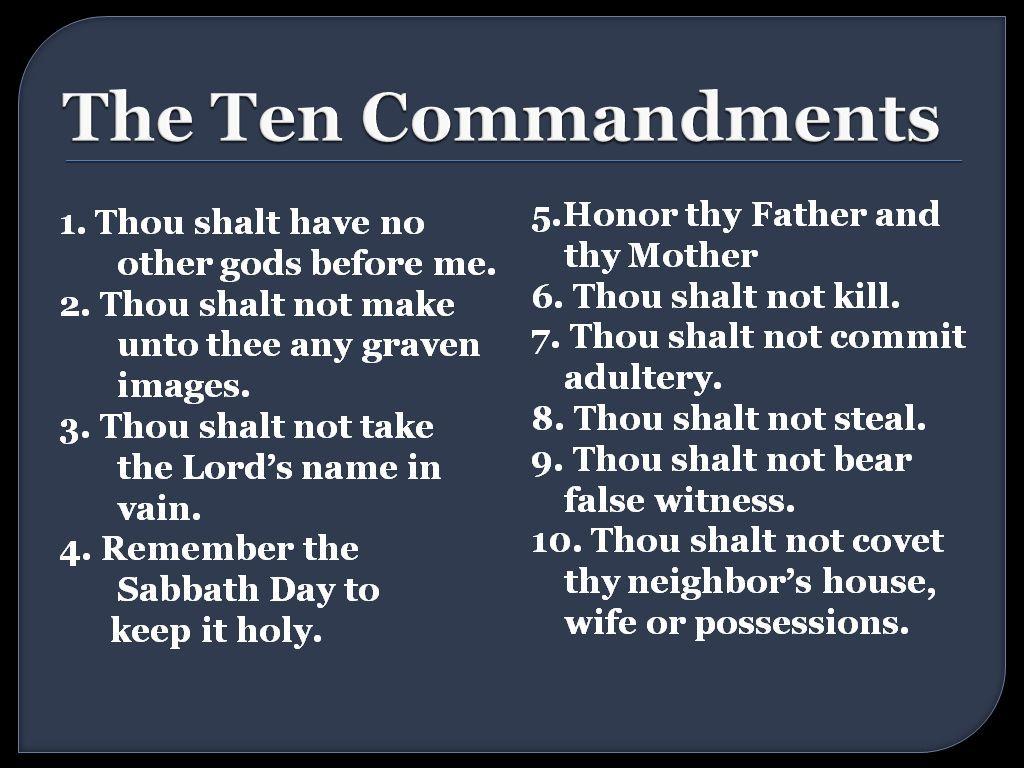
Recently some Christians have been asked to support proposals that would require school systems to display signs or posters containing the Moral Law (Ten Commandments). (See: https://wallpapercave.com/wp/wp2492760.jpg ) Those requests present more than one dilemma for knowledgeable Christians.  

Historically, many Christians’ initial lessons about the Bible were related in the context of the celebrations of the birth of our Lord Jesus (“Christmas”), or His death on the Cross followed by His Resurrection (the secular celebration of “Easter”).  These annual observances were accompanied by “gift-giving” and sometimes “special family meals”,  bringing joyfulness, especially to children. These practices continue today.

Other Christians’ first learning of the Bible became manifest through exposure to posters or charts / sign displaying the Ten Commandments as noted above. (See Exodus 20: 1-17). At an early stage of their learning, some were told that these “Ten Commandments” represent God’s instructions to Christians as to how we were to live our lives.  Even so, the context through which these Commandments were given was seldom, if ever, given.  After seeing them, the readers generally would find “nothing objectionable”, or even that they “made good sense”.

I highlighted the term “context” because that is a very important factor that causes the dilemma faced by knowledgeable Christians who might be asked to respond to the question raised in the title of this post.  To better explain, I’d like to provide some of the context that a Christian should consider before being definitive in answering the question.

Once again I caution all Christians and other Bible students to remember and follow the advice of the Scripture itself, and the knowledgeable scholars who came before us.  We should:

·       rightly divide the word of truth” (Scripture) distinguishing what was written to the Nation of Israel under the Law of Moses (2 Timothy 2: 15); even as we…recognize that

·       “All Scripture is given by inspiration of God, and is profitable for doctrine, for reproof, for correction, for instruction in righteousness…” ( 2 Timothy 3: 16-17); and further, being mindful of the words of advice given by the early Bible Translator, Myles Coverdale:

·       It shall greatly help ye to understand the Scriptures if thou mark not only what is spoken or written, but of whom and to whom, with what words, at what time, where, to what intent, with what circumstances, considering what goeth before and what followeth after.”  https://en.wikipedia.org/wiki/Myles_Coverdale )

[I know the words above are ones I’ve used frequently, but they embrace much of what and how Christians and other Bible students learn. Repetition really does enhance learning!] 

As we’ve previously discussed, our Lord Jesus in His Preincarnate form as Israel’s LORD God (Jehovah) gave the Mosaic Law, including these Ten Commandments to Israel in Exodus Chapter 20.   For some context we need to first look at Exodus Chapter 19.  There we see that Israel’s role was to serve Him as a “kingdom of priests”…and “an holy nation”. {Verses 1-6)  In those capacities Israel was to serve to bring to the Gentile world knowledge of their God and His standards for moral behavior. (Deuteronomy 4: 5-14; Isaiah 49: 6; Zechariah 8: 18-23)   That same mission was later confirmed and relayed by the Lord Jesus in His Incarnate form during His Earthly Ministry as He instructed His Disciples. (Matthew 18: 18-20)…and again, following His Crucifixion, death and Resurrection before His Ascension back to the Father. (Acts 1: 6-9).

It is important to remember that all these instructions were given by the Lord specifically to the Nation of Israel. It was not yet time for His message to go to the Gentiles. (Matthew 10: 1-7)  As God, He foreknew that Israel would reject Him as their Messiah and King by influencing the Romans to bring His death through crucifixion .  After His Ascension, the Lord turned to Saul of Tarsus (later named Paul) to be His messenger  / Apostle to the Gentiles. (Acts 9: 1-16; Romans 11: 13)   (See also: https://www.gotquestions.org/apostle-to-the-Gentiles.html  

I’ve given all these points of “context” for generating a response to the title question.  They are important areas for consideration in addressing the Christian “dilemma” as noted above.  Among other revelations and instructions given by the Ascended Lord to the Apostle Paul, one in particular stands out for this discussion.    Although the Moral Law and the other parts of the Mosaic Law do reflect God’s standards for man’s behavior (Psalm 19: 1-8), God knew that man would not be able to fully obey them. (Deuteronomy 27: 26; James 2: 10; Galatians 3: 10)  [For further consideration by readers of this post, I recommend your reading Romans Chapter Seven. It provides a valuable perspective of the life of believers not explained elsewhere in the Scripture.]

Through Israel’s practical experiences in attempting to follow the Law, they were to come to the realization that they could not be successful. After learning that no man could achieve that full compliance, Israel would then have been in a stronger position as “priests for the LORD in His Kingdom” to educate the Gentiles (Matthew 4: 23; 9: 1-2)  They would have been in a position to share with the Gentiles the truth…as the Bible would later inform us.

But Israel’s failures led the Lord to reveal to Paul the true purpose of the Law… to clarify and make man knowledgeable of how God defines sin. (Galatians Chapter Three)  Remember that the reason God gave the Moral Law to man was clearly help us overcome the sin-nature that all mankind had inherited from the first man Adam. Without understanding what behaviors constituted “sin” in God’s eyes, man was destined to continue in the path that had led to God’s having to destroy earlier generations through “Noah’s Flood”  (Genesis Chapter Six).   That knowledge of “sin” would lead man to understand that the solution to overcoming the curse of death inherited from Adam (Genesis 2: 15-17), could only be found by the faith in believing that the Lord Jesus has already paid that death sentence for us. (Genesis 3: 15; John 3: 14-18; Romans Chapter Five; Romans 8: 1-4)

With that additional context, the dilemma lies in additional considerations including:

·       Is it feasible or even desirable to pursue sharing or teaching the Ten Commandments if the primary objective is to share the Gospel of our Lord Jesus?  

·       Further, if the Law is to be taught, what are the qualifications for the person(s) who should teach it?

·       What input should be sought from parents and other responsible adults?

·       At what age would young children be able to distinguish between the truths of Christianity and what they might be taught about other religions?  

·       If the venue for such teaching were a public facility, how should Christians react when advocates for other religions seek equal time or other resources?

Another part of the dilemma Christians might face in addressing this issue is based on the assumption that the parents are the ones who best know and therefore should teach their children. However, the current situation suggests that the parents themselves are generally not fully educated about the Ten Commandments or many other messages of the Bible.

Perhaps it would be better for all parties concerned if this issue had not been raised, or now that it has been raised, maybe it should be ignored.

As a rhetorical question, how would you answer the question raised in the title of this post?

Dr. W. A. (Bill) Robinson

https://christianityandbiblestudy.blogspot.com

Monday, May 18, 2026

Bible Study of Prophecy and Symbolism


Bible Study of Prophecy and Symbolism


While reading the Bible, Christians and others sometimes encounter challenges in interpreting the Scripture. We are advised to remember the classic advice given by the Bible translator Myles Coverdale, who said: ”  “It shall greatly help ye to understand the Scriptures if thou mark not only what is spoken or written, but of whom and to whom, with what words, at what time, where, to what intent, with what circumstances, considering what goeth before and what followeth after. ” ( https://en.wikipedia.org/wiki/Myles_Coverdale )  We also are to remember the advice given by the Apostle Paul to his young protégé` Timothy, when he said: “ Study to shew thyself approved unto God, a workman that needeth not to be ashamed, rightly dividing the word of truth. (2 Timothy 2: 15) (Bold emphasis added)  But often these and other guides are not enough. 

Especially during these latter times we are well-advised to read, study and understand “Bible Prophecy”. Although there are many Scriptural statements regarded as “prophecy / prophetic”, I have chosen one specific area for the focus of this discussion.  My aim is to encourage you to not be fearful when you encounter symbolism, especially in prophecy. ” It doesn’t have to be a daunting experience.

A general definition of this concept pf prophecy can be found on the Internet.  I chose the following: “prophecy is a message that has been communicated to a person (typically called a prophet) by a supernatural entity. Prophecies are a feature of many cultures and belief systems and usually contain divine will or law, or preternatural knowledge, for example of future events. They can be revealed to the prophet in various ways depending on the religion and the story, such as visions, or direct interaction with divine beings in physical form”. (https://en.wikipedia.org/wiki/Prophecy ) (Underline and Bold Emphasis added.)

There is also a definition of “symbolism” found on the Internet that I chose, that says: “Symbolism is a literary device used extensively throughout the Bible to convey deeper meanings and spiritual truths. It involves the use of symbols—objects, figures, or colors—to represent abstract ideas or concepts.” (Underline Emphasis added) (https://biblehub.com/topical/u/understanding_symbolism.htm ) .  Many Christians and other Bible students are familiar with  Scriptural references to our Lord Jesus as the “LION of the Tribe of Judah”, or the “LAMB of God”, using the characteristics of these animals to convey certain of His traits in a way that man might better understand.


Sometimes the Bible will quickly tell the reader the meaning of the “symbol” in the Scripture itself, to facilitate understanding.  At other times the reader should continue reading because the Bible generally interprets itself.

The Bible’s use of symbolism in prophecy is most prominent in the Books of Daniel, Ezekiel and Revelation.  Interestingly enough, across these Books several of the symbols are either identical or closely related even though they were written many hundreds of years apart.

One of the most classic examples of symbolism is found in the Book of Daniel. To provide some context for the prophecy of Daniel,  remember that this was the same Daniel who had been captured as a young teen along with the people of the Nation of Israel when they were conquered by the Babylonians in approximately 600 B.C.  (Daniel Chapter One)  But in his captivity, Daniel had received high favor from God who gave him special revelations of prophecy.  His revelation and interpretation of the “Great Image” seen by Babylonian King Nebuchadnezzar in his dream would outline the events of the future of mankind, especially for the Gentile world, but including Israel. (Daniel Chapter Two)  I encourage you to read this Chapter at your convenience. 

For other examples, at the point in history of Chapters Seven and Eight, Daniel was receiving a related, prophetic vision from God. Here we see the use of some specific “animals / beasts” and their characteristics as a recurring theme that crosses the Scripture. Some of these symbols are explicitly explained in the Scripture, while others are left to the reader to investigate their meaning.  [As an aside, other than the Scripture itself, the reference tool that has been most helpful to me in this discussion is my “New Strong’s Expanded Exhaustive Concordance of the Bible”. Thomas Nelson Publishers, 2010, Nashville, Tennessee, USA.]

In his vision, Daniel saw these animals / beasts that we see as Symbols:

·       Lion – (Daniel 7-4) – Strong’s Hebrew Dictionary # 738, 39): “lion; frequent figure of power and strength; lion of God, i.e. heroic: lion-like men”

·       Bear – (Daniel 7: 5) – Strong’s Hebrew Dictionary # 1678; (Revelation 13: 2) Strong’s Greek Dictionary # 715): “bear”

·       Leopard – (Daniel 7: 6) – Strong’s Hebrew Dictionary # 5245); (Revelation 13: 2) Strong’s Greek Dictionary # 3917: “leopard”; …but note the following additional information provided in that last Strong’s reference: “an animal characterized by swiftness of movement and sudden spring, in Daniel 7: 6, symbolic of Alexander the Great, and the formation of the Grecian kingdom, the third seen in the vision there recorded. In Revelation 13: 2, the imperial power described there also as a ‘beast,” is seen to concentrate in himself the characteristics of those mentioned in Daniel 7.” (Emphasis added) 

Note the explanation and description of Alexander the Great and his Greek kingdom as “the third seen in the vision”. 

Before continuing with the list of these animals / beasts, it is important to recognize that the Bible Scripture identified the “symbols” but in these instances did not clarify their meanings, except for the “leopard”. However, as we continue reading in Chapter Eight, we see some clarification:

·       Ram – (Daniel 8: 3-4) – Strong’s Hebrew Dictionary # 352) “ayil”: “a ram (from its strength); Many passages use “ayil” as a figure of despot or mighty men. …The king of Babylon deported Judah’s kings, princes, and the ‘mighty of the land’.” Note this reference to the “ram” as symbolic of  Nebuchadnezzar, the king of Babylon who defeated Israel and captured Daniel in approximately 600 B.C.  As we continue reading the Chapter, the Bible informs us that the Angel Gabriel explains the symbol of the ram in Verse 20, saying:” The ram which thou sawest having two horns are the kings of Media and Persia.” We know from Bible history that the Medes under King Darius defeated the Babylonians, and then the Persians under Cyrus continued to rule over Israel. (Daniel Chapters 5 and 6) (Emphasis added)

·       Goat – (Daniel 8: 5, 8) – Strong’s Hebrew Dictionary # 5795, #6842): “male goat”; As noted above, the Angel Gabriel further explains the symbol of the goat, in Verses 21and 22, saying: “And the rough goat is the king of Grecia: and the great horn that is between his eyes is the first king.  22 Now that being broken, whereas four stood up for it, four kingdoms shall stand up out of the nation, but not in his power.”    Whereas we noted above the symbol of the “leopard” referring to Alexander the Great, we see in this vision of prophecy that the “goat” is also his symbol as the king of Greece. The language of Verse 22 helps confirm this symbol because we also know that when King Alexander died (his “horn” broken) his kingdom was left under the control of his four generals. (See: https://biblehub.com/topical/t/the_four_successors_of_alexander.htm )

In the process of describing these various animals / beasts as symbols used in prophecy, we also encounter other symbols.  For example, the use of the word “horn” appears many times.

·       Horn -  (Ezekiel 29: 21; Daniel’s Chapters 7 and 8) – Strong’s Hebrew Dictionary : # 7161, -62;  - (“horn; a peak of a mountain; figuratively “power”;   (Luke 1: 69; Revelation Chapters 5, 9, 12, 13, and 17) - (Strong’s Greek Dictionary # 2768; - “a mount” (mountain) in Palestine.  These references to both a ‘mountain” and “power” is often considered a reference to a “kingdom” among “lesser hills”.  Note in the Scripture cited above related to the symbol of the “goat”, the Angel Gabriel said: “…the ‘great horn’ that is between his (king of Grecia) eyes is the first king.”  This symbol is a reference to a king and his kingdom.


As another example, in his prophetic vision of heaven, the Scripture recorded the Apostle John (the Revelator) saying” …there were seven lamps of fire burning before the throne (of God) , which are the seven Spirits of God.  (Revelation 4: 5)  One of my teachers (Les Feldick) noted that this symbolism was consistent with the words of the Prophet Isaiah who described the coming of our Lord Jesus approximately 700 years before His Advent. (Isaiah 11: 1-2) 

In another example,  the Book of Ezekiel, Chapter 37 is sometimes referred to as the “Dry-Bones Chapter”.  As you read that Chapter with its reference to “dry bones”, you note that the “bones”  are similar to those of a skeleton that has been left in the hot, dry sun for a long period of time.  It isn’t until Verse 11, and beyond that you are told that those bones are symbols of the twelve tribes of the Nation of Israel that had been scattered / displaced from their homeland. The prophecy is that the LORD will give the 12 Tribes new life as a Nation, and restore them to their homeland. [ You will recall that Israel declared its independence and became an Independent State in May 1948.  (https://www.history.com/this-day-in-history/May-14/state-of-israel-proclaimed ;  https://en.wikipedia.org/wiki/Israel )]

Most of Bible prophecy has not yet come to reality.  But we should be knowledgeable about where we currently stand at this point of Bible history, and what lies ahead. As “Ambassadors for Christ” we need to be able to accurately inform others what the Scripture has told us.

Again I encourage you to use these examples, and the reference resources of the Strong’s Expanded Concordance Dictionaries,  the Internet, and others references (as long as they are consistent with God’s word), to supplement the Bible Scripture itself.  As we study, we will continue to encounter symbols, both within and outside of the Bible’s many prophetic statements.  The key is to embrace the opportunity to investigate their meaning to better understand God’s messages to mankind.

Dr. W. A. (Bill) Robinson

https://christianityandbiblestudy.blogspot.com

Saturday, May 2, 2026

References to “Heaven” in the Holy Bible


References to “Heaven” in the Holy Bible

While preparing for my most recent blog post titled “Christians and the Planet Earth”, it was apparent that I needed to review other references related to the position of our planet in our Universe. Knowing that the Bible’s first mention of the Earth came in the Book of Genesis’ description of God’s Creation, I looked to Genesis Chapter One, Verse One, that says: “In the beginning God created the heaven and the Earth.”  (Underline added)

Because that Chapter further describes the term “heaven”, I read along to Verses Six through  Eight that said:  And God said, Let there be a firmament in the midst of the waters, and let it divide the waters from the waters.  And God made the firmament, and divided the waters which were under the firmament from the waters which were above the firmament: and it was so.  And God called the firmament Heaven. And the evening and the morning were the second day.

That explanation of the term “heaven” seemed clear in identifying the area above the Earth in the atmosphere in which we see the clouds.  However, continued reading added to that description, even adding the specifics of how far the “heaven” extended from the surface of the Earth.  The Scripture records in the later Verses 14 through 19, that on the fourth day of the Creation, “ 14 And God said, Let there be lights in the firmament of the heaven to divide the day from the night; and let them be for signs, and for seasons, and for days, and years:…”  That expanded description includes the areas of the Earth’s moon and our Solar System, and potentially our entire Universe.

To get further clarity of the definition of “heaven”, I turned to my key reference Strong’s Expanded Exhaustive Concordance.   From previous Bible studies, we know that it is important to review the information provided for a given word in both the Hebrew and Greek / Aramaic Dictionaries of the Concordance.  What was written for the Nation of Israel does not mean that it has the same meaning or interpretation for Christians and other Gentiles. (Romans 15: 4; 2 Timothy 2: 15, 3: 16)

In the Hebrew Dictionary, the word “heaven” (Strong’s # 8064 – “shamayim / shameh”) has the general definition saying: “the sky (as aloft; the dual perhaps alluding to the visible arch in which the clouds move, as well as to the higher ether where the celestial bodies revolve)”.  Importantly, that description applies to 398 of the total of 420 times the Hebrew word is used in the Old Testament, while an additional 21 times it simply means “air”. Following that definition there is a narrative under the heading “Introduction” that provides an excellent, more detailed discussion of the word “heaven”.  That expanded narrative includes the following excerpts which tell of Heaven being “the dwelling place of the Most High and the angels of God”;  …”where He is, there the true heaven is”; …”the highest heaven [literally the heaven of heavens]…”  I highly recommend that you the entire section under “Introduction”, which includes the location in the Scripture for the various quotes.

In the Greek / Aramaic Dictionary, the word “heaven” (Strong’s # 3772 -  “ouranos”) has the general definition saying, “the sky; by extension heaven (as the abode of God); by implication , happiness, power, eternity; specifically the Gospel (Christianity):  Importantly, that description applies to 268 of the total of 284 times the Greek / Aramaic word is used in the New Testament, while an additional 10 times it simply means “air”, and 5 times it means “sky”.  Following that definition, the narrative continues with an emphasis on our Lord Jesus Christ.  Some excerpts of that narrative include: “…(heavens) created by the Son of God”;…”From thence the Son of God descended to become incarnate,”…”In His ascension Christ ‘passed through the heavens’,”… “He ‘ascended far above all the heavens’,”; and more.  Again I encourage you to read the entire section.  

And most importantly for Christians, they support much of our belief in our Lord Jesus, and our future with Him.  From the latter Greek / Aramaic Dictionary, I share this additional  narrative describing heaven: “Thither Paul was ‘caught up’, whether in the body or out of the body, he knew not, 2 Corinthians 12: 2; …It is to be the eternal dwelling place of the saints in resurrection glory, 2 Corinthians 5: 1; …From thence Christ will descend to the air…to receive His saints at the Rapture , 1 Thessalonians 4: 16; Philippians 3: 20, 21, and …will subsequently come with His saints and with His holy angels at His second advent, Matthew 24: 30; 2 Thessalonians 1: 7, …and further for Christians believers in the Gospel today, …”In the present life ‘heaven’ is the region of the spiritual citizenship of believers, Philippians 3: 20.

Note that what was revealed to the Nation of Israel in the Hebrew Dictionary offers both significant similarities and significant differences from that revealed to Christians in the Greek / Aramaic Dictionary definition of the word “heaven”.

Collectively, however, these narratives affirm the existence of heaven at three levels…1) the air / atmosphere where the clouds form and the birds fly; 2) where the moon, sun and stars are located in what we call “outer space” or our “Universe’; and 3) where God lives. But they also affirm why God will have to destroy the first and second heavens as mentioned in my most recent post, and noted in the first paragraph above. (See also Isaiah 65: 17, 2 Peter 3: 13; Revelation 21: 1) Under the influence of the Enemy / “god of this world”, man has contaminated both the first and second heavens (including through “space travel”, satellites, etc.), in addition to the Earth itself.  They must be replaced with the New Heavens and the New Earth, to make them suitable for eternity.

Dr. W. A. (Bill) Robinson

https://christianityandbiblestudy.blogspot.com

Why Did God Choose the Middle East for Jesus – Part Two

  Why Did God Choose the Middle East for Jesus – Part Two In Part Two of this post under the same title, we will look further at (1)   thi...