Why the Apostle
Paul Was Forbidden to Preach in Asia*
(*Note
“Asia” refers to the Region of “Asia Minor” that borders on the Mediterranean
and Aegean Seas)
While
studying in the Book of Acts, I was challenged by the meaning of a couple of
verses. I learned a couple of lessons while trying to decipher them, so I’m
sharing them now.
Background: The verses in question are part of the Scripture
that describes the Second Missionary Journey of the Apostle Paul who was
travelling to spread the Gospel of Grace. Paul had recently returned from a
trip to Jerusalem during which he had met with Peter, James and others of the
leadership of the Church there. That was the historic meeting known as the
“Jerusalem Council”. After a contentious
debate, it was agreed that the Jerusalem
followers of Jesus would continue to evangelize the other members of the Nation
of Israel under the Gospel of the Kingdom, and they would not interfere with
Paul’s sharing the Gospel of Jesus’ Grace to the Gentiles. (Acts Chapter 15; Galatians 2: 1-10)
Then, as Paul
and his supporters began their trip to territories that bordered on the
Mediterranean Sea, the Scripture recorded the following in Acts 16: 4-7:
4 And as they went through the cities, they delivered them
the decrees for to keep, that were ordained of the apostles and elders which
were at Jerusalem. 5 And
so were the churches established in the faith, and increased in number daily.
6 Now when they had gone
throughout Phrygia and the region of Galatia, and were forbidden of the Holy
Ghost to preach the word in Asia, 7 After they
were come to Mysia, they assayed to go into Bithynia: but the Spirit
suffered them not. (Underline
added).
My question was “Why was Paul forbidden by the Holy Spirit to
preach the Gospel in Asia?” There was no apparent explanation given. The
term “assayed” in Verse Six meant that they tried to test whether they were truly
“forbidden”, but the Spirit was persistent. (See Strong’s Concordance Greek
Dictionary # 3984 and 3985)
As Paul continued his journey bypassing Asia he came to Troas /
Troy. The Scripture then says in Verses
9 and 10: : “9 And a vision appeared to Paul in the
night; There stood a man of Macedonia, and prayed him, saying, Come over into
Macedonia, and help us. 10 And after
he had seen the vision, immediately we endeavoured to go into Macedonia, assuredly
gathering that the Lord had called us for to preach the gospel unto them. (Underline added.)
From that Scripture, it seemed that perhaps logically God saw a
higher priority in Paul’s message reaching Greece, rather than moving into Asia
/ Asia Minor. Then I remembered a point raised by one of my teachers (Les
Feldick Ministries), that the insistence of the Holy Spirit that Paul take his
message Westward to Greece was to serve a different purpose. Pastor Feldick opined
that it was the first step towards moving the Gospel to Europe, following the trail
of the generations of Noah’s son Japeth, where Christianity would flourish and
later spread to the Americas.
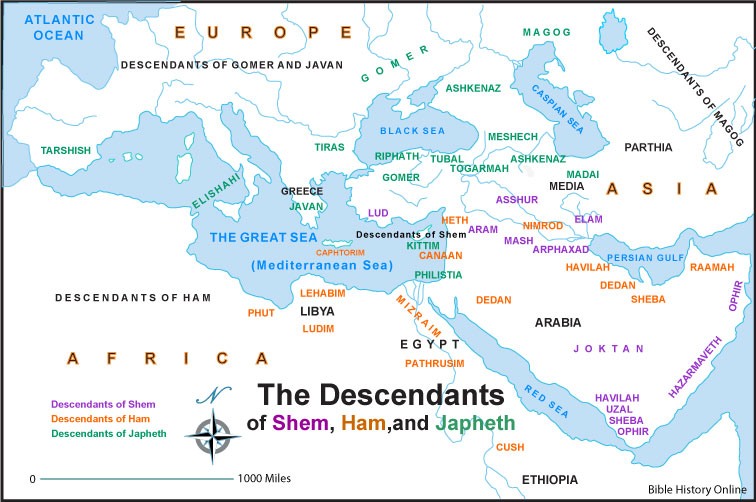
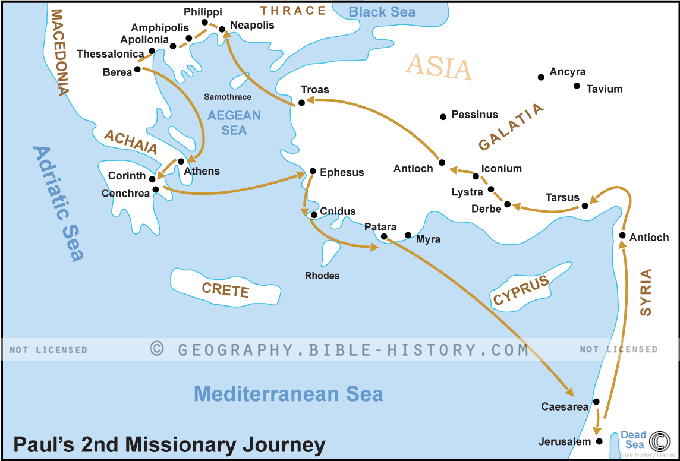
I then attempted to compare the maps of the migrations of the
generations of Noah’s sons (Shem, Ham and Japeth) to a map of Paul’s Second
Missionary Journey. See:
https://bible-history.com/images/common/desc-shem-ham-japheth.jpg ; and
https://bible-history.com/images/common/acts-pauls-second-missionary-journey.png
The comparison of the maps confirmed that both the
descendants of Japeth, and the Apostle Paul travelled North and West around the
coasts of the Mediterranean Sea. However, the detail of the map of Paul’s
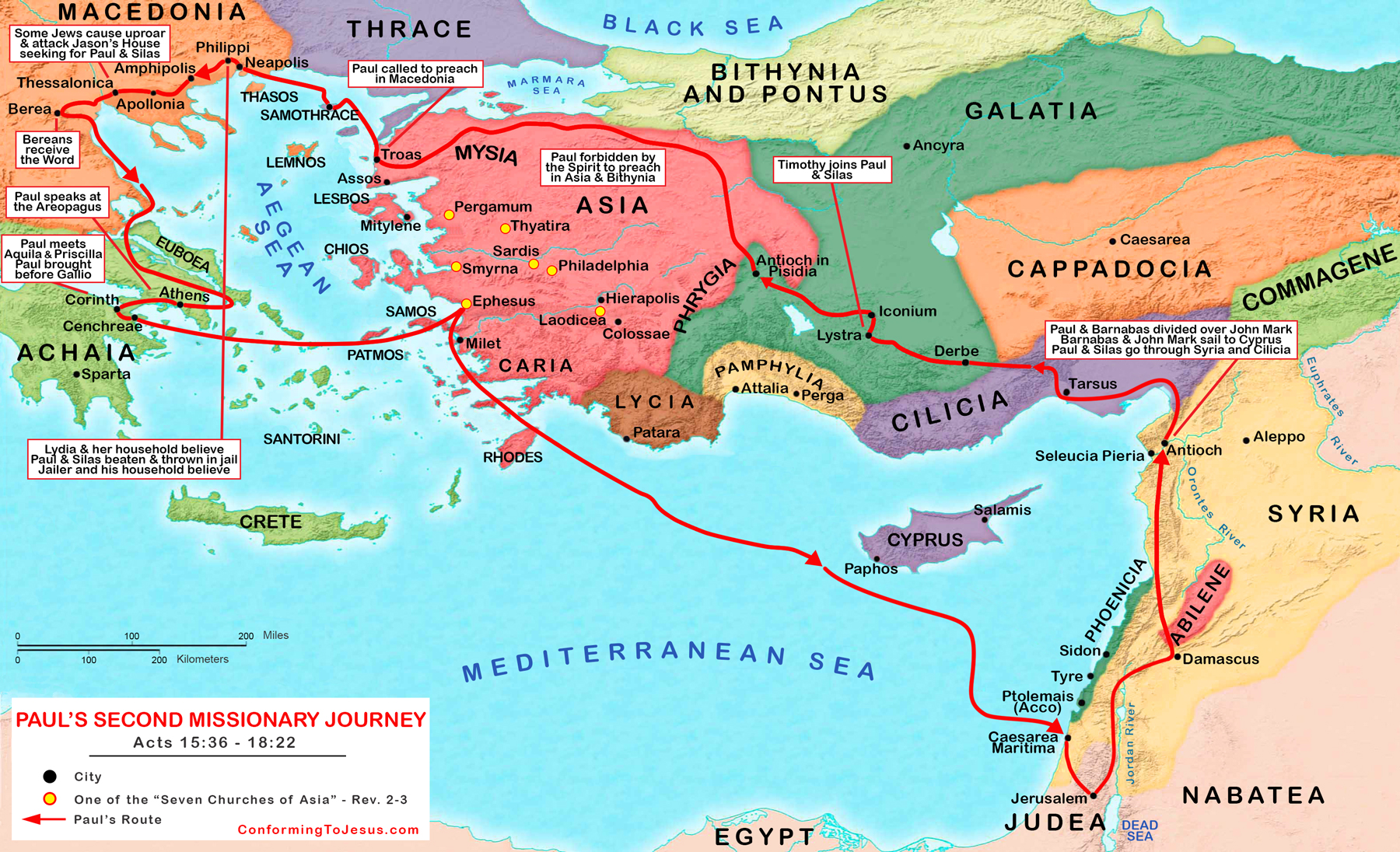
Second Missionary Journey was less than I preferred, so I searched for another.
The result showed a pleasant surprise. See:
https://www.conformingtojesus.com/images/webpages/apostle_paul_second_missionary_journey_map1.jpg

If you look closely at the region of the map labelled “Asia”, you
will find seven small yellow circles / markers. Each identifies one of the “Seven
Churches of Asia” highlighted in the Book of Revelation, Chapters One
through Three. It was in that Scripture that the Ascended Lord Jesus gave
the revelation to His former Disciple, the Apostle John. John was imprisoned on the nearby Isle of
Patmos, where the Mediterranean and Aegean Seas meet. It was there that the Lord Jesus gave His critique
of each of the seven churches and their leaders.
His reviews were recorded by the Holy Spirit for
our learning. I strongly encourage you to read these three chapters at your convenience.
All this caused me to reconsider and question again “why the
Apostle Paul was forbidden to preach in Asia”. Although it wasn’t highlighted in the Lord’s words,
I’d like to provide some additional context.
The Seven Churches of Asia were not composed of Gentile believers. Their congregants
were members or relatives of the Nation of Israel who had been scattered from
the Jerusalem Church. Note the numerous references in the Scripture to the
“golden candlesticks” / Menorah, kings, priests, kingdom, etc. They all had significance to Jewish believers related
to the Gospel of the Kingdom, but not to Paul’s Gentile believers. Israel’s Temple in Jerusalem was destroyed by
the Romans in 70 A.D. John wrote the
Book of Revelation circa 95 A.D. By the time of the Ascended Lord’s revelation
to John, Paul’s journeys had been completed, and he had been martyred circa
65-68 A.D.
By forbidding Paul to preach in Asia, it could have been that the
Holy Spirit wanted to maintain the unity of the message being given to the Seven
Churches. The Churches had been established under the common bond of believing
the Gospel of the Kingdom, with the Lord Jesus as their Messiah and future
King. Further, per the agreement of the
Jerusalem Council, Paul was to limit his preaching of the Gospel of Grace to
the Gentiles.
On the other hand, the Holy Spirit might have wanted to make the
priority of moving the Gospel Westward to Greece as suggested above.
Or perhaps there was another reason.
That is part of what makes Bible study so interesting. God keeps
things secret until He is ready to reveal them.
(Deuteronomy 29: 29) . It is also
why we must continue reading the entire Bible to better understand what He has revealed.
(2 Timothy 3: 16)
Dr. W. A. (Bill) Robinson
https://christianityandbiblestudy.blogspot.com


No comments:
Post a Comment